Showing posts with label classroomreality. Show all posts

When a student forgets a pencil...

About five years ago, I had a really impromptu conversation with a fellow teacher from down the hall.  I asked her how she handles students who forget or do not have a pencil with them when they come to class.  After this conversation, I asked a number of other teachers how they handle the same situation.  Some were pretty black and white:

"I will ask them to borrow one from a friend."
or
"I will let them go back to their locker, but only three times each quarter."
Other teachers were less stringent in their responses:
"It depends if it is the first time or a repeat offender."
and
"I have a collection of brand new and used pencils in a drawer.  Students can borrow them anytime."
Still others saw the pencil conversation through a different lens.  For several, the answer was a lesson in economics.
"I want students to understand the need to come prepared, so I have them for sale in my room."
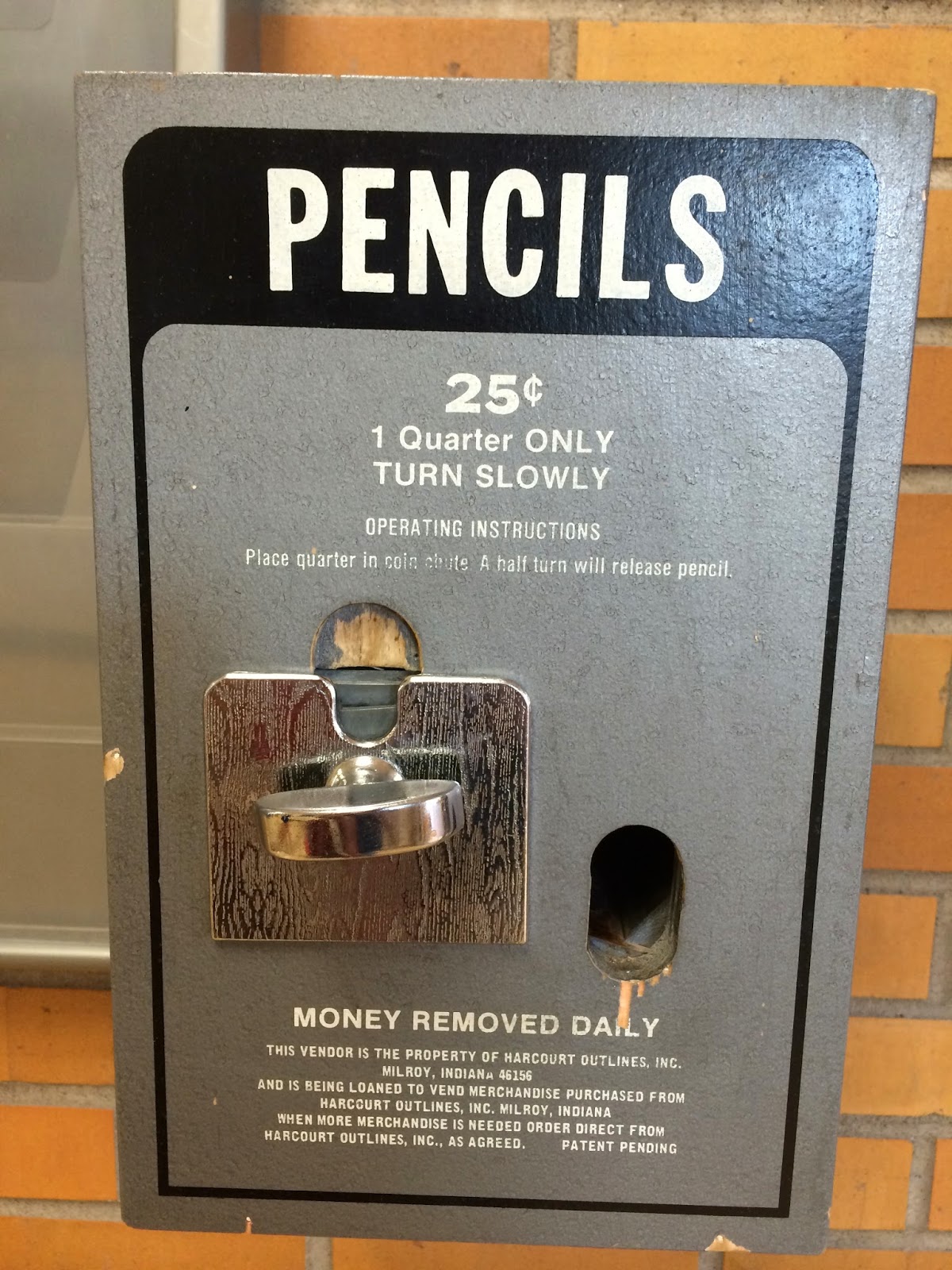
I was reminded of the economics of forgetting a pencil when I recently visited a school over an hour's drive from home.  I couldn't help but take a picture of it with my phone:


As a teacher, I'm pretty sure I tried all of these ideas at one time or another.  For some reason, this classroom scenario has stuck with me for a number of years.  It brings up a number of other questions (in no particular order):
  1. What does the way a teacher handles students who forget pencils, say about his/her educational philosophy?
  2. What does the way an administrator handles adults who do not come prepared to meetings or professional learning, say about his/her educational philosophy?
  3. Is the way a forgetful administrator or teacher expects to be treated similar to the way he/she treats staff and students in the pencil context described above?
  4. How would you want the teacher of your children to handle the "I forgot my pencil" scenario?
I think I have many more questions than answers right now.


Walking the Walk: Administrators teaching (take 2)

I was at our high school this afternoon doing some administrative walk throughs when my day changed for the better.

Algebra teacher [half joking]: "Do you want to teach my next class?"
Me: "What is the lesson?"
Algebra teacher: "Factoring trinomials.  It's a challenging class of students."
Me: "I'm up for it."
The Algebra teacher started the class and went through the practice problems from the previous night.  She introduced me and I took over from there.

Before I reflect on this experience, I want to provide a bit of context:

  • Some of these students had siblings who were my former students.
  • The Algebra class I taught was comprised primarily of 9th and 10th grade students who are fulfilling a math graduation requirement.
  • I taught factoring once in my student teaching experience, but never in my own classroom.
I started off by sharing a little bit more about myself: You may see me in the buildings from time to time, often in teachers' classrooms.  I work in the central office, but taught high school math several years ago.  

Next, I shared about the importance of learning math in high school and the community college remedial math course problem.  Looking back, I'm not sure why I did this.  It was one of those spur of the moment decisions that seemed right for the audience.  I used to share this annually with my Geometry classes when the time seemed right.

Next, I asked students to get out of their seats and work with a partner on a few math problems linking previous learning to today's lesson.  "Factor....why doesn't this one factor nicely?"and "FOIL...what is the connection between FOIL and factoring?"  Finally, we discussed (Think, Pair, Share) leading coefficients, FOIL and how to factor trinomials in a slightly different way today when compared to the previous lesson.  It wasn't 3-acts, but with fifteen minutes to prepare, it was the best I had to offer these teens.  

A few take-aways from today's teaching:
  • In my previous "administrator becomes the teacher" experience, I knew some of the students and had previously taught the lesson.  Today confirmed that a blind relationship with the students and content makes teaching even more challenging.
  • Even though I did not have time to check for understanding, I felt like the activities activating students' prior knowledge were meaningful.  Philosophically, I believe math is "applying what you know to a new situation" which entails making connections every day between previous and current learning.  
  • Classroom management can be a challenge without a seating chart.  The teacher provided me with a copy of her seating chart, but in the moment I resorted to pointing at students rather than addressing them by name. A few students tried to test the boundaries with a new guy in the room, so I established myself early with some wait time and "teacher looks."  As it turns out, the student who was asked to leave the room due to his antics was extremely apologetic and claims he is not an issue for the classroom teacher.  
Overall, it was again a positive experience.  Should all administrators teach a lesson from time to time?  I think so.  I did not have an established rapport with many of these students before I stepped in to teach, which may or may not be the experience of a building administrator.  

As I drove back to my office for a meeting, I felt energized.  I missed the opportunity to provide several teachers with walk through feedback, but I grounded myself in a sea (okay, maybe a small drip) of classroom reality.  I look forward to debriefing with this teacher later in the week to see if my instructional strategies were effective through the lens of her and her students.  

Back to the office.  Back to the emails, voice mails and paperwork.  It was all worth it.  

Found on a course syllabus in the wild...

"Attitude, effort, and participation are considered in the grading process.  On occasion, students may earn participation points.  Late work, missing work, unexcused tardies, off-task behavior and poor attitude will result in a lowered participation score for that week."
(Emailed to me from a colleague in another district in Iowa)

Discuss.


Teaching isn't easy. Neither is being a school administrator

Context:


I taught high school math for six years.   No doubt, it was challenging.  I grew frustrated with the generalizations that teaching was an easy occupation and that the solutions were simple.

Here are a few fictitious examples that aren't necessarily related to pedagogical strategies learned in teacher prep programs:

  • motivating Suzie who doesn't see the need to graduate high school
  • helping Johnny learn the three big ideas he missed while he was out sick for two weeks
  • working with Amanda, a student who is having difficulties focusing in school because her parents are going through a divorce at home.
Add in the complexity of assessment and grading that many of us are interested in and the job doesn't get any easier.  Providing quality feedback to students is great in theory, but challenging in practice.  Bill lays it out nicely here. 

-------

I'm in my second year as a district administrator.   No doubt, it's a challenging gig, too.  I'm equally frustrated with the generalizations and simple solutions related to professional development and instructional leadership.  

Here are a few fictitious examples that aren't necessarily related to leadership strategies learned in administrator prep programs:
  • confronting Jeff, a staff member who is allegedly stalking a co-worker
  • delegating tasks to Brenda, a secretary who continuously tries to undercut her supervisor's authority
  • working in an office without a secretary once Brenda has been let go
Add in the ongoing balance of management tasks such as government and legal regulations with instructional leadership activities such as classroom walk throughs and meeting with teams of teachers -- the job doesn't get any easier.  

-----

The purpose of this commentary isn't to suggest that one occupation is more challenging than the other.   It is merely a way I hope to briefly illustrate the complexities of both roles.   I believe many of our challenges lie within the system rather than the people themselves.  Teachers and administrators, let's work together to find solutions to the challenges we both face in the system!


Blast from the past: Myths and realities of student teaching

[Nostalgia]

Originally published in the April 5, 2004 Wartburg Trumpet, a student-run college newspaper.

Nearly eight years later some things have changed while others have stayed the same.  Feel free to make your own connections in the comments below.


Myths and realities of student teaching
by Matt Townsley, Columnist

Get up around seven, teach kids for six or seven hours, and then come home and relax with your college friends.  This is often the life of a student teacher, right?

From the outside, it may seem like a semester of student teaching would be less stressful and involve fewer evening hours of preparation compared to the typical academic load.  Based of my experiences of ten weeks of student teaching thus far, I beg to differ.

Because a fair number of the friends I have made here at Wartburg also major in education, I do not often hear the stereotypes surrounding education majors, but I have managed to catch a few.  With those thoughts in mind, I hope to clear up a couple of myths that are often attached to student teaching.  

Myth #1 - "Student teachers have an easier daily schedule - they have evenings off!"
During student teaching, it's vital that school building hours are observed.  For me, this entails being at school from 7:30 a.m. until 3:30 p.m or 8:00 a.m. until 4:00 p.m., at the very least.  So, yes, evenings are typically unscheduled, but events such as parent-teacher conferences fill the evening hours at least once per semester for us.  Furthermore, I spend on average one to three hours each evening creating lesson plans, checking papers, writing assessments and working on my student-teaching portfolios.  For the duration of my seven semesters of academic study at Wartburg, I have never had 10 straight five-day weeks with constant activities eight until four.  In fact, there were more days that I slept in past eight in the morning because my day did not begin until nine or 10.  True, I did have various organizational meetings in the evenings, but those were by choice and were not necessarily pertinent to the next day's activities like lesson planning, paper grading and test writing are presently for the student teacher in me.

Myth #2 - "Student teachers just teach, check papers and do other regular teacher duties."
Part of this myth is true.  Student teachers do teach, check papers, write tests, attend teachers' meetings and discipline kids. In addition to being a teacher, we must journal on a semi-daily basis, create at least one portfolio to be turned in at the end of the semester displaying our progress and reflective thoughts, complete and review a wide array of paperwork before each of six Wartburg personnel observational visits and attend evening seminars on a weekly or bi-weekly basis.   More specifically, secondary student teachers are required to turn in a portfolio addressing our progress towards meeting the Iowa Teaching Standards, various reflection pieces describing how our student teaching placements addressed various components of the Wartburg Education Department Knowledge Base, a small research project proving that students are actually making academic progress in our classrooms and an assessment of our personal professional growth during the twelve weeks of teaching.

To sum it all up, student teaching is an experience like none other.  It is more than just a trial run at becoming a teacher.  It is a test of endurance, perseverance and daily excellence.  If nothing else, it is going to make me appreciate being a "student" once again for my final May Term on Wartburg's campus. 

Are my grades accurate?

A teacher at a neighboring school district that I've consulted with previously recently emailed me a question.

"I am looking at my grades for my classes and I am a little worried that my grades for my students are maybe too good. There is no one with a C or less. I obviously don’t want my students to do bad but shouldn’t there be at least one student that isn’t doing good?..."
This email could have just as easily asked...
"...There is no one with a B or better.  I obviously want my students to do well, but shouldn't there be at least one student that is doing well?..."
Here was my response:

  • Be less concerned with the number of A's, B's, C's, etc. students are earning in your class.
  • Be more concerned with ensuring the grades students are earning accurately represent their current level of understanding.
  • Be more concerned that your grading system ensures students have an opportunity to demonstrate their understanding at any given time within the grading period, not just "by the test date."
  • Be more concerned that you've clearly communicated the purpose of your grading system with parents and students.
From assignment-based grading to standards-based grading
It's worth double checking.  Are our grading systems setup to communicate current levels of understanding or do they continue to report point accumulation based on assignments?

What did I forget in my response to this teacher?

Walking the walk: Administrators should teach, too.

Nearly one year ago, I accepted a job as curriculum and technology director in the district I had taught high school geometry and statistics in for six years.

Everyone once in a while I hear someone suggesting that administrators should also be part-time teachers or should at the very least teach a lesson once in a while to be reminded what it feels like to be in the trenches.  I decided to walk the walk and give it a try...in my old classroom.  (Thanks Mrs. R. for your willingness to give up the reigns for one class period!)

Before I reflect a bit on this experience, I want to provide a bit of context.

  • The statistics class I taught today was comprised of students who choose to take this elective course.
  • Approximately 50% of the students in the class were familiar with my personality and teaching style because they'd had me as an instructor previously.
  • Because I've taught this course previously, I had an idea of some of the common misconceptions students might have related to this topic.
  • I visited this same classroom the day before for approximately 45 minutes to get a feel for the classroom culture and procedures.
  • Today was basically the first day of the last half of the class.  It was the day students would transition from thinking about statistics as purely descriptive to inferential as well.
I started off with the same type of bell ringer the classroom teacher typically uses.  This went fairly well. A few students did not come to class with their materials, so I let them borrow a calculator or go to their lockers.  This was par for the course in my former teaching days.  It was a bit awkward introducing myself at first, I forgot to explain what my role is now until halfway through the class period, and I never did tell the students why I was guest teaching for the day.

After introductions and starting to tell a story about how I didn't get much sleep last night due to my excitement leading up to this teaching opportunity (true story), the fire alarm went off.   There was a scheduled fire drill that I wasn't aware was going to take place.  Luckily, the classroom teacher had planned to be in the room to observe, so she grabbed the seating chart and we headed out the door.  It was a momentum killer, but that's part of teaching, right?  

Once we returned back to class, I led a high energy Q&A/ session to gain a better understanding of the pre-requisite descriptive statistics knowledge base.  I then continued my story about how I usually get wired whenever I'm lacking sleep.  This led into asking how many hours of sleep students had last night.  I used a Flip camera before school to record about twenty students answering the same question, so we used this data to lead into inferential vs. descriptive statistics.

Following a get-out-of-your-seat check for understanding activity, we finally launched into confidence intervals.  I had a nice activity ready (that I'd used in the past) involving candy to help students better understand this concept, but a quick glance at the clock told me there was no chance it was going to fit in.  The interactive Q&A was intermingled with a few statistics jokes (Math teachers reading this know what I mean!) seemed to keep students' attention for a while longer.  Finally, we made it to the meat and potatos of the lesson: constructing our first confidence interval.  I'm still thankful for the student who made the connection between confidence intervals and the Central Limit Theorem or I might still be in that classroom trying to explain where today's formula came from.  

With ten minutes left in an 84 minute block, I had one last small check for understanding opportunity before students could begin their practice problems.  My biggest fault of the lesson: I did not have a solid plan (and, as it turned out, enough time!) to continue the formative assessment cycle to figure out how to help students close the gap on the last big idea for the day.  Ugh.  I don't "know if they know" and that's not good.  

Overall, it was a positive experience.  Should all administrators teach a lesson from time to time?  I think so.  Is it easy?  Even though several contextual areas were in my favor, it was more difficult than I anticipated.  I had a case of the "first day of school" butterflies going into this opportunity and I obviously missed the boat on the assessment side of things towards the end of the block.  I cannot imagine teaching a discipline I've never taught before or being a first year administrator and teaching a class comprised of students I had no previous rapport.  Regardless, I'm looking forward to stepping back in the classroom again, at least on a semi-annual basis.  Sure, I'll be spending extended time in the office digging out from the time I spent away today, but it was well worth it.

Teachers: do your administrators ever guest teach for you?  
Administrators:  do you ever offer to teach for your teachers?  What have your experiences been in this area?

One post can make a difference

Monday: 

  • Middle school principal  blogs about it his smart phone purchase over Christmas break.

Wednesday: 

  • Middle school teacher reads principal's blog and decides to give cell phones a try in the classroom.

Thursday: 

  • Middle school teacher consults with district media specialist (Kathy is a rock star, if you haven't met/followed her yet) who sets him up with our district PollEverywhere account and shares a link with him about cell phone use in the classroom.
  • Middle school teacher comes up to my office to explain it all with comments such as... "I told the kids I might be the only teacher in this school that does not own a cell phone, but it's time we start using them responsibly in our classroom" and "Tomorrow, the kids in my class will bring their phones.  Two of them do not have phones and they're going to use a laptop from the computer cart so they're not left out.  They walked out of the room excited."  
Vocabulary word definitions will no longer be scripted by the teacher.  Instead, students will come up with a common definition based on the resources at their finger tips.  

Students will no longer raise their hands when they want the teacher to slow down.  Instead, they will push a button on their phone to set off the ring tone.  

I'm told these were both student ideas.  I'm looking forward to visiting this classroom tomorrow (Friday) to see it in action.  The excitement I have is not centered on the technology tool -- it's about the change in pedagogy, the change in control from the teacher to the student.  

It's amazing how one post can make a difference. 

Proofs, triangle congruence and a reality check.

Kate Nowak blogged about it first.  Evan Abbey asked for this post.  Here goes nothing.

I teach Geometry therefore I also teach proofs, specifically two-column proofs about congruent triangles.  It's a Geometry student's nightmare.  Ask a Geometry alumnus what they didn't like about Geometry, chances are it's proofs.

Aside from showing the "girls are evil" proof, it used to be one of my least favorite topics to teach.  Honestly, who cares if two triangles are congruent?  Furthermore, who cares to prove two triangles are congruent "given" some sort of figure marked up with congruent sides and overlapping angles?  Yeah, yeah, we need to expose our students to this type of recipe-like logical reasoning.  Yeah, yeah, we should be exposing our students to mathematical proof in the unlikely event one or two go on to become math majors.  For the super-majority of my students, Geometry is the first and last time they'll see congruent triangles as well as two-column proofs.  It's up to me to make it a little bit interesting.

Here's how it all shook down a few months ago:
Me: Let's say I tell Tommy to go home and cut out a triangle with three sides: 3 cm, 4 cm and 5 cm.  He's really good with his protractor, ruler and scissors and won't mess up the triangle.  I give the same instructions to Sandy - go home and cut out a triangle with three sides: 3 cm, 4 cm and 5 cm.  Sandy is also really good with her protractor, ruler and scissors.  Would they come back tomorrow with the exact same triangle?

Student A: No way!  They will definitely be different.  Just because they have the same sides doesn't mean the two triangles will be exactly the same. 


Student B: Yes!  The same three sides means it will be the same exact triangle.

Me: Interesting thoughts.  Who thinks Student A is right?  Who thinks Student B is right?  How about this scenario:  If I tell Randy to cut out a triangle with three angles...40 degrees, 45 degrees and 95 degrees and Leslie to do so as well, will both of these students come back tomorrow with the same triangle?


Student A: No way!  They will be different, just like Tommy and Sandy's triangles.

Student B: Yes!  There's only one way to draw a triangle with those angle measures.

Student C: Yes!  I've done it before, Mr. Townsley.

Me: Wow.  Who thinks Randy's triangle will be the same as Leslie's triangle?  Of those of you that voted yes, how many of you also think Tommy and Sandy's triangles will be the same?  How many of you think that there's a difference between these two pairs of triangles?

...and the conversation continues until a student finally says, "let's try it out!!"
-----------------------------------------------
Over the next class period, pairs of students cut out 12-15 triangles and test some conjectures I propose.  Are two triangles with congruent and corresponding angles always going to be congruent?  What about two triangles with congruent and corresponding sides?  What about a combination of angles and sides?

Will many of my students (and yours) ever think about triangle congruence theorems and/or two-column proofs again outside the math classroom?  Probably not.  In my earlier years of teaching, I used to motivate this kind of lesson with some sort of artificial "real-world" problem.  I'm starting to learn that its often more engaging and meaningful to address the math for what it is rather than pretending it is immediately applicable to adolescents' lives.   Pure mathematicians:  can/should a high school math teacher get away with this type of rationale or am I providing a disservice to my students?

Mission Impossible: Teaching High School Math

You probably already caught it on Dan's blog, but if not the first 40 seconds are worth repeating:

"Can I ask you to please recall a time when you really loved something...a movie, an album, a song or a book and you recommended it whole heartedly to someone you really also really liked and you anticipate the reaction and you waited for it and it came back and the person hated it...so by way of introduction, that is the exact same state in which I spend every working day for the last six years.  I teach high school math.  I sell a product to a market that doesn't want it, but is forced by law to buy it.  It is just a losing proposition."  - Dan Meyer
 Check out the TEDxNYED video for the rest of the twelve minute talk on math education.


Maybe there's a reason why teaching secondary math is considered a shortage area in Iowa? (pdf)

On the road again!

Last week, I had an afternoon Iowa Core district leadership team meeting on Monday and had a sub again all day Wednesday to attend the Iowa 1:1 Institute.  I will be gone again for a full day to start the week to co-present with Kathy Kaldenberg, Shannon Miller, and Deron Derflinger at the IASL Spring Conference.

I typically try to schedule written assessments for days I'm out of the classroom.  It is pretty easy for a substitute teacher to hand out a test or quiz and have students hand them into the basket when they're done.  Once students work on some review problems after the assessment, it pretty much fills up an 84-minute block. 

Well, being out of the classroom this often doesn't lend itself to easy planning.  There just aren't enough written assessments I can give to my students right now.  So, I decided to try yet another experiment in virtual education, this time in my Statistics & Discrete Math course. 

First, students will be asked to watch this video explaining the day's activities- a late night clip created by me with my MacBook and its build-in iSight camera.
Second, after reading a few pages from the textbook, students will watch this video from the textbook's website to see an example of a hypothesis test being worked out. 
Last, students will complete several problems from the textbook to practice the hypothesis test algorithm.

The last day we met together, we did several activities explaining the concept behind hypothesis testing, so they should be vaguely familiar with much of the terminology presented in the examples.  This virtual setup is far from ideal, but aside from assigning more busy work, it is the only way I could think of to push forward knowing that not many substitute teachers have a deep understanding of hypothesis tests. :)

What other great ideas are out there for keeping students busy (as sad as it sounds) AND learning while you're out of the classroom?

I took off points for THAT on the quiz, you'd think they learned!

I've been a part of a handful of conversations lately that go something like this:

-----------
"On the quiz last week, students were asked to label their graphs.  Half the class didn't, so I took off two points."

"Oh, really?  That's pretty frustrating."

"On the test today, guess what?  The same kids forgot to label their graphs.  I tell you, Matt, it was right there in the directions...you'd think they learned...."
---------

We (math teachers) think that taking off points for incorrect or missing labels, forgetting to answer part of a question or not turning in homework is THE solution.  Does it really work though?  In my experience, for the most part, the same students continue to make the same mistakes over and over.  They need to be taught soft skills of becoming more detailed readers and writers or following directions carefully - some of them need help...reading!  By taking off points, what message are we sending to students?

I don't know the answer.  Maybe more critical conversations with students rather than relying on points and grades to do the talking?  Thoughts?  Leave 'em in the comments.

Mile wide and an inch deep...is there a sliver of value in this approach?

Warning: unpolished thoughts (a.k.a. rambling) follow...

A colleague recently sent an article describing the age-old problem of math topic coverage being a mile wide and in inch deep.  A few excerpts from the article are enough to illustrate the main points math curriculum crisis transpiring in the state of Florida right now:

"The problem with the old standards, educators say, is that many topics were covered lightly and then repeated year after year."
 and
"Because the state's annual test measured performance on the 89 standards, Kuches and other teachers had no choice but to race through them in the hope that students would learn. The results were not always good, especially for slower learners."
I used to think that this problem could be quickly fixed...just teach fewer topics and explore them from many different angles so that ALL students can understand them.  After a dozen or so semesters teaching, Geometry, I still think this is a good idea in theory, but I have also realized that some young minds just aren't mature enough to comprehend certain math topics.  Think about Bloom's Taxonomy (or a more specific math example, van Hiele levels of geometric reasoning) and how some students struggle with the knowledge or comprehension level of many topics in school.  In Geometry, our curriculum (i.e. proofs, inductive and deductive reasoning) implies students should be synthesizing and evaluating geometric ideas.  From my experience, that's just not cognitively possible for some students as fifteen or sixteen year-olds.  It might not be possible until they are seventeen or eighteen.  If the topics don't repeat themselves, at least a little bit, students will be missing out on the opportunity to be exposed to these ideas later on in their "math career." 

I do like the approach of only teaching several big ideas each year during middle school math, but I'm just not sure if its reproducible at the high school level.  Some spiraling of topics seems to make sense, but how much is too much given what we know about adolescents' cognitive abilities?  I am by no means an expert in adolescent psychology, so I'm hoping y'all are able to chime in with your thoughts and experiences.

What do pre-service education departments need to know?

In April, I will begin serving a two-year term on the advisory committee for the education department at a small liberal arts college here in Iowa.  The commitment is two one-hour meetings per year.  Members include the general public, two students majoring in education, teachers (that's me) and administrators who work in schools that the college places their student teachers. 

"The role of the council is to advise the department on issues related to curriculum, pre-service methods classes, student teaching, and other matters related to the field of education."  
Aside from David Cox's suggestion of bringing up standards-based grading (don't worry, I will!), what else do pre-service education departments need to know from classroom practitioners?  Leave your thoughts in the comments below.  I'll do my best to represent YOU, my faithful blog readers. :)

Making sense of standards-based grading with parents

Do you think your grading system confuses students and parents?  An email I received this morning confirms it:

 (click through to view larger image)

This is yet another repercussion of grading pollution - parents want to help their children, but they aren't sure what the source of the low grade is...effort or understanding!

My guess was that the parent had not talked with her son, because she did not know that I report out learning target understanding rather than single assessment scores (i.e. Test 1: 95%).  Either way, here was my response:

--------
Good morning, _______,
The grades you see in PowerSchool report both _____'s work ethic and his understanding of Geometry.  You will not see any "test" scores in PowerSchool.  Instead, you will see the concepts from each chapter listed and how well _____ understands each concept.  Take a look at the screenshot of ______'s Geometry grades in PowerSchool:


 (click through to view larger image)
 
If you click on "Ch. 1 L2" you will see the concept that _____ was tested on.

 (click through to view larger image)
 
_______ is currently at a "2" level (out of 4) when it comes to understanding basic terms of Geometry.  The scale for each learning target is:

Each Learning Target is scored using a 4-point scale:
4 – demonstrates thorough understanding
3.5 – high level of understanding, but with small errors
3 – demonstrates understanding, but with significant gaps
2 – shows some understanding, but insufficient for a passing grade
1 – Attempts the problem

This means that he does not understand this particular concept very well at all.  Does that make sense? 
You will also see scores that report out ______'s work ethic.  I enter in how many assignments _____ has turned in each week.  For example:


 (click through to view larger image)
 
Last week, ______ did not turn in several assignments.  If you click on the "Weekly assignments and warm-up: 2/8 - 2/12" you can read more information about the week's assignments that were turned in.  The actual practice homework assignments are listed daily on my website.....

---------------------

Two thoughts that came to mind from this email conversation:
  1. Reporting out homework completion to parents may be a good data point, even though it doesn't make sense for it significantly impact a student's final grade. 
  2. Contrary to lesson #1, would it have been easier if I didn't report out weekly homework completion, so that my response would have merely been, "I only report student understanding of learning targets.  It is safe to assume that if your child is not doing well, it is because he/she doesn't understand the big ideas."  
On a side note, perhaps the teacher next door and I are starting a revolution in grading practices in our building.... and all this communication about grades will be unnecessary in a few years?!

Teaching is easy, right?

Read the curriculum guide and follow the standards.  Come up with some engaging problem-based learning ideas.  Differentiate.  Use some computers and cool web 2.0 tools so that your classroom doesn't become dangerously irrelevant.  Assess students in authentic ways.  Talk about collaboration and critical thinking.  Easy stuff, right?

A day in the life of Mr. Smith:

2nd period ends in frustration.  The computer cart checked out in Mr. Smith's name for the class period was not where it was supposed to be.  In fact, Cart A ended up being in Mr. Craig's room, even though he hadn't checked out the cart for the past three days.  Go figure.  Two senior boys enjoyed their time walking the school hallways looking for it though.  It took an announcement over the PA to find Cart A.  So much for giving students time in class to write about their data collection and analysis project ideas and submit them via Moodle.  If only every student had a computer of their own, this wouldn't be a problem.

Betsy walks in shortly before the 3rd period bell.  She's been out for the past week due to surgery and came back yesterday, but Mr. Smith didn't have time to catch up with her one-on-one.  Today is the chapter test and Betsy still has several unanswered questions even though she completed most of her homework assignments before she left.  In mid-sentence, Mr. Smith is interrupted by Jenny who informs him that she will be gone to Hawaii next week for vacation and needs her make-up work tomorrow.

The bell rings. 

Students begin their warm-up problem and check their answers to last night's homework.  Five different students have five different questions about the review assignment.  The rest of the class yawns or dozes off while Mr. Smith takes time to go over these five problems before the test.  Mr. Smith applauds the six unnamed students who took the time to come in before school to get help on the review assignment and encourages ALL students to follow suit in the future.

It's time for the test to begin.  Mr. Smith tells the students to get out their formula sheet (also known to students as their "toilet paper"...don't ask why) and clear their desks.  Thanks to a last minute print job, Mr. Smith informs the students about a typo on page three of the test.

Finally, students begin the test.

Mr. Smith circles the room for a few minutes and then checks his email.  Mr. Lair, the principal, has sent out a friendly reminder about Mr. Smith's role in the next day's staff meeting.  Great.  Something else to work on tonight in addition to checking the tests.  Mr. Smith fires an email back, "sounds great.  I'll make it happen!"  A few minutes later, the office secretary calls - James needs to leave right now.  His mom is ready to take him to his doctor's appointment and needs to leave within two minutes.  A quick discussion about finishing the test takes place between James and Mr. Smith.  Suzie walks up to Mr. Smith, "What am I supposed to do with the test when I'm done?"  Mr. Smith rolls his eyes and points to the red basket.

Five minutes later, Lance raises his hand and whispers, "Do I have this problem setup right?"
Mr. Smith responds, "If I answered that question, I'd have to put MY name on your test.  I can't tell you the answer to that question." 

The bell rings. 

Mr. Smith's day has just begun.  He thinks to himself, "I thought teaching was supposed to be easy."