June 2014: One of the most exciting months ever for Iowa educators?

*Dr. Tom Guskey is coming to Des Moines (Thank you, Drake University!)
Target audience? K-12 educators and administrators
When? June 18, 2014
Cost? $150
Description:
As educators align instruction and assessments with the Common Core standards for student learning, most find they also must change their grading policies and revise their report card. Learn how to develop new standards-based grading policies and practices that are better for ALL students, gain the support of parents, and don’t create excessive work for teachers.


**The Iowa Competency Based Education Conference is returning to Des Moines (Thank you, Iowa ASCD!)
Target audience? K-12 educators and administrators, higher education
When? June 23-24, 2014
Cost? $250 for Iowa ASCD members and $295 for non-members of Iowa ASCD.
Description:
Come learn how students can learn and demonstrate competencies which will endure throughout time. CBE provides a strong framework for teachers and administrators to understand the Iowa Core and ensure students are college, career, and citizenship ready.

Among the featured speakers include Rose Colby, author of Off the Clock and Tom Vander Ark, author of Getting Smart.  Several Iowans will be joining the conversation and sharing their expertise, including the pilot schools of the CBE collaborative.


***A few Iowa practitioners are leading a two-day standards-based grading workshop in Cedar Rapids (Thank you, Grant Wood AEA!)
Target audience? Secondary teachers and administrators (pre-service students and faculty welcome)
When? June 30 and July 1, 2014
Cost? $80 or $160, depending on credit
Description:
This course will highlight grading and assessment practices described in contemporary educational literature. Beliefs about assessment, homework and grading will be challenged and refined as they relate to the Iowa Core Curriculum characteristic of effective instruction, assessment for learning. Participants will learn how to grade based on state standards.

Will June 2014 be one of the most exciting months ever for Iowa educators? 

--
*Dr. Guskey might be the godfather of standards-based grading, if there ever was one.
**For what it's worth, I believe there are distinct similarities and differences between standards-based grading and competency-based education.
***It's a shameless plug: I am one of those two guys.  I hope you'll consider attending the other two events, but I think we'll be involving participants in a hefty dose of standards-based grading at the classroom level.  It's the cheapest option and in my opinion, the biggest bang for your buck.

When a student forgets a pencil...

About five years ago, I had a really impromptu conversation with a fellow teacher from down the hall.  I asked her how she handles students who forget or do not have a pencil with them when they come to class.  After this conversation, I asked a number of other teachers how they handle the same situation.  Some were pretty black and white:

"I will ask them to borrow one from a friend."
or
"I will let them go back to their locker, but only three times each quarter."
Other teachers were less stringent in their responses:
"It depends if it is the first time or a repeat offender."
and
"I have a collection of brand new and used pencils in a drawer.  Students can borrow them anytime."
Still others saw the pencil conversation through a different lens.  For several, the answer was a lesson in economics.
"I want students to understand the need to come prepared, so I have them for sale in my room."
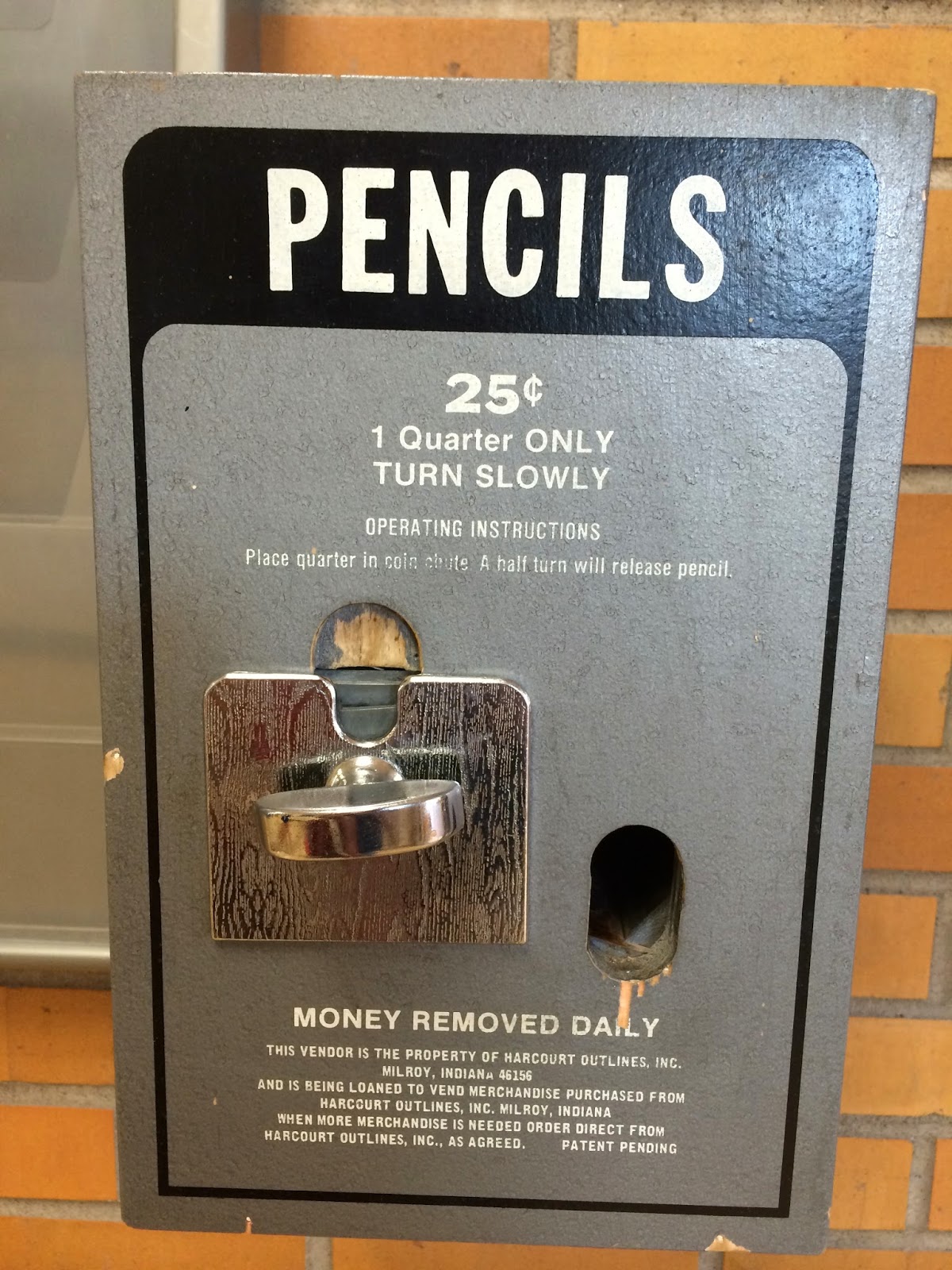
I was reminded of the economics of forgetting a pencil when I recently visited a school over an hour's drive from home.  I couldn't help but take a picture of it with my phone:


As a teacher, I'm pretty sure I tried all of these ideas at one time or another.  For some reason, this classroom scenario has stuck with me for a number of years.  It brings up a number of other questions (in no particular order):
  1. What does the way a teacher handles students who forget pencils, say about his/her educational philosophy?
  2. What does the way an administrator handles adults who do not come prepared to meetings or professional learning, say about his/her educational philosophy?
  3. Is the way a forgetful administrator or teacher expects to be treated similar to the way he/she treats staff and students in the pencil context described above?
  4. How would you want the teacher of your children to handle the "I forgot my pencil" scenario?
I think I have many more questions than answers right now.


Win with Reading!

Students in our elementary school are challenged to read, read, read, read.  If we meet our participation goal, the elementary principal will kiss a pig!

I will be sharing my love for reading with several classes during the next few weeks.  This morning, I started my day with fourth grade students reading a children's version of Who's on First?


Thank you, 4E!

Musings on Iowa Core, Common Core, Next Generation Science Standards and Smarter Balanced Assessments

Iowa Core, Common Core and Next Generation Science Standards
Information I've gathered:

  • The idea of statewide standards for Iowa's high school students started in 2005.  Between 2005 and 2008, the work expanded into K-8.  (Source)
  • The original Iowa Core essential concepts and skills included math, literacy, science, social studies and 21st century skills.  The skills were broken down into grade bands (K-2, 3-5, 6-8, 9-12).  

For the first time, students in Marshalltown were expected to learn the same things as the students in Mason City.  Iowa was the last state in the country to adopt state standards.
  • In 2009, drafts of the common core state standards were released to the public.  These math and literacy standards were a result of a movement initiated by the National Governors Association and Council of Chief State School Officers (Source)

In summary, Iowa currently has a mix of standards that are state specific and standards other states have also voluntarily adopted.  All of these standards are collectively referred to as the Iowa Core Essential Concepts and Skills.  
  • Math: Common Core State Standards (with several additions), **grade-specific
  • Literacy: Common Core State Standards (with a few additions) **grade-specific
  • Science:  state-specific (however, a task force has recommended Iowa adopts the Next Generation Science Standards), grade bands
  • Social Studies: state-specific, grade bands
  • 21st century skills: state-specific, grade bands
A group is currently lobbying fine arts to be included in the Iowa Core Essential Concepts and Skills as well.  


Smarter Balanced Assessments
Information I've gathered:
  • Iowa Code currently requires Iowa students to take math, science and literacy Iowa Assessments (formerly Iowa Tests of Basic Skills and Iowa Tests of Educational Development) in various grade levels for federal and state accountability requirements. 
  • A task force will/may suggest requirements for a new assessment that is better aligned to state standards. 
  • Iowa is a member state of the Smarter Balanced Assessment Consortium (SBAC).  The Smarter Balanced Assessments are one of two assessments (PARCC is the other) currently being created to assess the common core math and literacy standards.  
  • Any new assessment(s) resulting from the task force's recommendations could be Smarter Balanced Assessments, a new form of Iowa Assessments or something totally different (or we could stick with current Iowa Assessments Form E.)  (See Twitter conversation below)
  • The task force is scheduled to meet through at least August 2014.
  • Smarter Balanced Assessments will be ready for 2014-15, so Iowa school districts would need to know at minimum prior to the beginning of the school year if they were required to use it.  
In October, I had a Twitter conversation about the Smarter Balanced Assessments with Dr. Brad Buck, Director of the Iowa Department of Education.


Looking ahead: Scenarios and questions 
  • It seems extremely likely Iowa schools will be administering Iowa Assessments during 2014-15 even though Iowa is member state in SBAC. 
  • Is it possible Iowa might require the Smarter Balanced Assessments for math OR literacy, but not both?  (This one seems really out in left field)
  • In the future, if Iowa were require students to take the Smarter Balanced Assessments rather than Iowa Assessments for math and literacy accountability, would Iowa Assessments still be required for science accountability?
  • If Iowa Assessments were phased out in favor of a new assessment, how would student "growth" be measured using the Iowa Assessments and a new test? 
  • Assuming Next Generation Science Standards are adopted by the state of Iowa, will the Iowa Assessments science test change as well?  Will a new science assessment at the national level be created that is more closely aligned with NGSS?

----

**CCSS math standards are broken down by grade level in grades K-8, however they are grouped together as one 9-12 grade band.  CCSS literacy standards are broken down by grade level in grades K-8, however 9-10 and 11-12 are grouped together as grade bands rather than by individual grades. 

Reading scholarly literature...as a hobby.

A while back, I began curating a list of standards-based grading related scholarly literature.  For a few weeks, it appeared as though I had hit a road block on new reading.   Then it hit me...

Step 1: Find a dissertation on a related topic, i.e. this one.  

Step 2: Download the paper for safe keeping.  (I prefer Dropbox to store all of my scholarly downloads, so they're accessible from nearly any internet-connected device)

Step 3: Head straight to the References section of the paper. 

Step 4a: Google the titles of sources cited in the references that look interesting.  

Step 4b: Search any academic databases (i.e. I have access to EBSCOhost through my school district) for the titles of sources cited in the references that look interesting.

Repeat Step 1 and if necessary, replacing "dissertation" with "article."

This process isn't anything earth shattering, but it has added a new layer of cognitive interest to my online reading during the past four weeks, so I thought I'd share it in this space.